How to Choose Disposable Piping Bags for Your Business: Thickness, Materials, and Certifications Explained (2026 Buyer's Guide)
The three specifications that matter most when buying disposable piping bags in bulk are film thickness (90–110 microns for professional buttercream work), film structure (co-extruded multi-layer PE outperforms single-layer LDPE at equal thickness), and a finished-product food-contact test report (FDA for the US, LFGB/EU 10/2011 for Europe). Price differences between suppliers almost always trace back to one of these three specs. This guide explains each one from the manufacturing side, so you can compare quotes accurately.
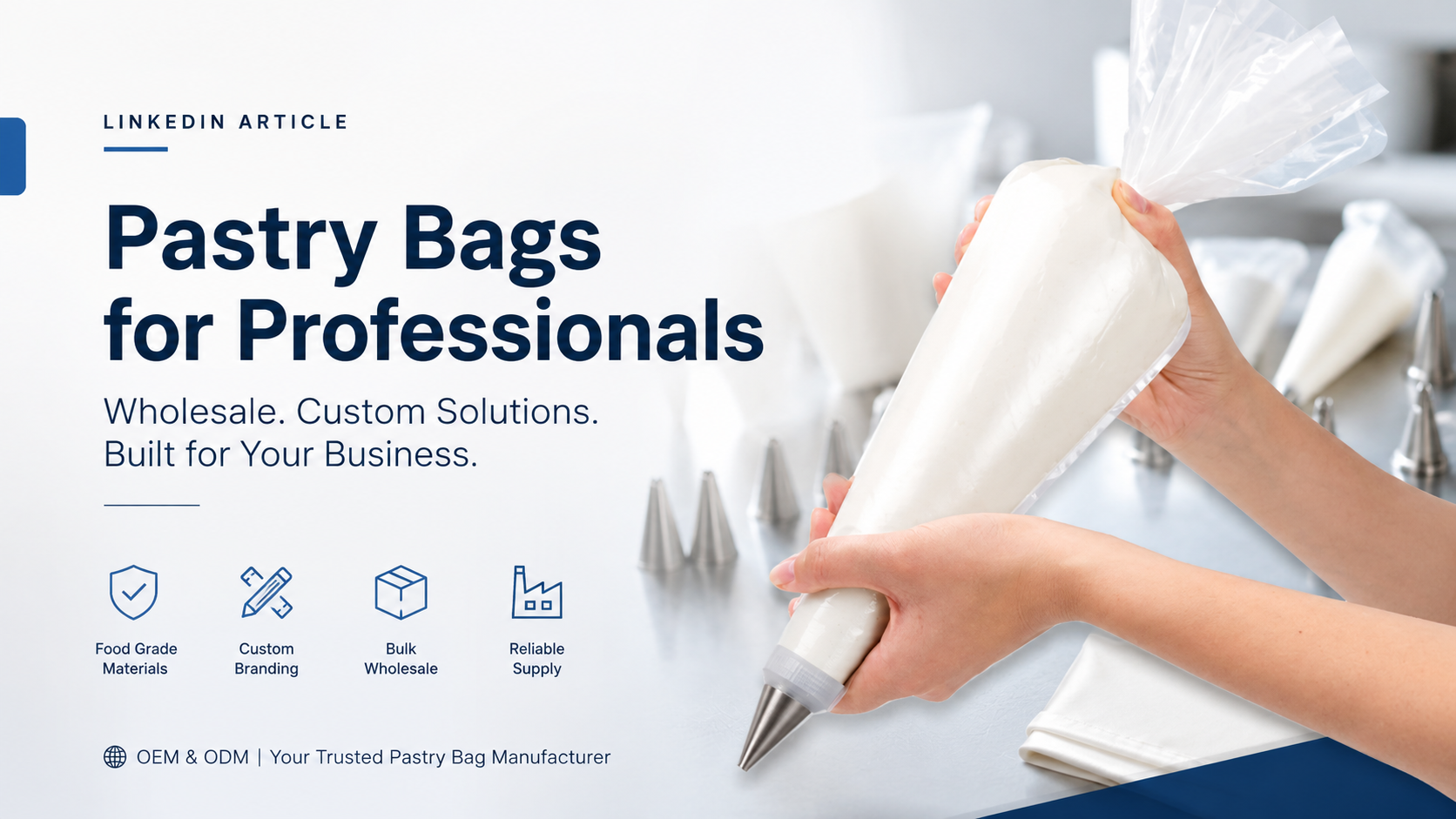
1. Thickness: the spec that decides everything
Disposable piping bags range from roughly 65 to 110 microns. Rule of thumb by use case:
| Use case |
Recommended thickness |
Film type |
|
Whipped cream, glazes, sauces
|
70–85 microns |
LDPE or co-ex |
| Buttercream, cream cheese frosting |
90–100 microns |
Co-extruded PE |
| Stiff royal icing, cookie dough, cold work |
100–110 microns |
Co-extruded PE |
A 10-micron difference changes raw material cost by well under one cent per bag at container volume — but changes burst rate dramatically. When comparing quotes, always normalize to the same thickness first; a cheaper quote at unstated thickness is not a comparable quote.
How to verify: measure incoming goods with a digital micrometer at three points (tip, middle, opening). Specify tolerance on your PI, e.g. "95μm ±5%".
2. LDPE vs. co-extruded film
Single-layer LDPE is the budget standard: acceptable for soft fillings, prone to tearing under pressure. Co-extruded film bonds 2–3 polymer layers, giving higher burst strength and puncture resistance at the same gauge — this is what "professional grade" disposable bags actually are. For wholesale buyers, the per-unit premium for co-ex is small; the reduction in customer complaints is not.
Seam quality is the other half of durability. A correctly welded seam is stronger than the surrounding film. QC test: fill with dense filling and squeeze along the seam — failure should occur in the film, never at the weld line.
3. Anti-slip texture
Embossed outer texture improves grip during long piping sessions with greasy hands. It adds one embossing step in production and a marginal cost. For retail brands targeting home bakers and professionals, textured bags consistently review better; for food-service bulk (rolls of 100), plain film keeps cost down.
4. Food-contact certifications: FDA, LFGB, EU 10/2011
• FDA (US market): compliance with FDA food-contact regulations for the finished product.
• EU 10/2011: the EU framework regulation for plastic food-contact materials.
• LFGB (Germany, and widely used as the strictest benchmark in Europe): includes sensory testing; passing LFGB generally implies comfortable EU 10/2011 margins.
Two verification rules for buyers:
0. The test report must cover the finished bag, not only the raw resin — extrusion additives and inks matter.
0. The report should be issued by a recognized third-party lab (SGS, Intertek, TÜV), dated within 12–18 months, in the manufacturer's name.
5. MOQ, printing, and packaging formats
• Plain bags: MOQ typically starts around [50,000] pieces per size.
• Custom-printed bags: plate costs mean printing amortizes above roughly 50,000–100,000 pieces per design.
• Lower-cost branding route: plain bags in a custom retail box or sleeve — suitable for smaller e-commerce brands.
• Formats: rolls of 100 (food service, lowest cost per bag), boxed retail packs of 100 (e-commerce), blister/header packs (supermarket).
6. Cost drivers ranked
From largest to smallest impact on unit price: thickness → size (12"–21") → film structure (mono vs co-ex) → texture → retail packaging → printing (volume-dependent). If a quote is significantly below market, the difference is almost always in the first two.
FAQ
What thickness should piping bags be for buttercream?
90–100 microns in co-extruded film. Below 85 microns, burst risk with stiff buttercream rises sharply.
Are disposable piping bags food safe?
Only if the finished product (not just the resin) passes FDA or LFGB/EU 10/2011 testing. Ask suppliers for a third-party report dated within the last 12–18 months.
What is the typical MOQ for custom printed piping bags from China?
Roughly 50,000–100,000 pieces per design, driven by printing plate costs. Plain bags with custom retail boxes offer branding at lower MOQ.
Why do piping bags burst at the seam?
Seam bursts indicate a factory welding defect. A properly made bag fails in the film before the seam. Test incoming batches by squeezing a filled bag along the weld line.
What's the difference between LDPE and co-extruded piping bags?
LDPE is single-layer and budget-grade; co-extruded film bonds multiple layers for higher burst and puncture resistance at the same thickness — the standard for professional-grade bags.
Anhui Province Tianle Plastic Co.,Ltd manufactures food-grade disposable piping bags (12-26”, 30–120μm, FDA & LFGB tested) with 3000TONS annual capacity, exporting to 50+ countries. Request samples or a spec sheet here: https://interpac.co/


